Programs at Sketch

A mixed-age kindergarten
for ages two to six.

A mixed-age kindergarten

Children of all ages,
growing together.

At Sketch, children between two and six share the same gentle space — not because we forgot to separate them, but because some of the most important learning happens across age.

Watch a four-year-old patiently hold a younger child's hand while crossing the garden, negotiating whose turn comes first, comforting a friend who has fallen. These are not distractions from learning. They are learning — empathy, leadership, language, emotional regulation, and social intelligence, practised in real relationships every single day.

Meanwhile, younger children absorb more than we can measure simply by being near older peers — picking up vocabulary, copying gestures of care, and stretching their own abilities because the bar is set just slightly ahead of them, not years ahead. The classroom mirrors real life more closely than age-segregated rooms ever could.

Soft watercolour sketch — young children sitting together on a rug, sharing a story

Two programs

Held through the whole day.

Morning

Morning Kindergarten Program

01.
Soft watercolour sketch — a young child kneading clay at a sunlit wooden table

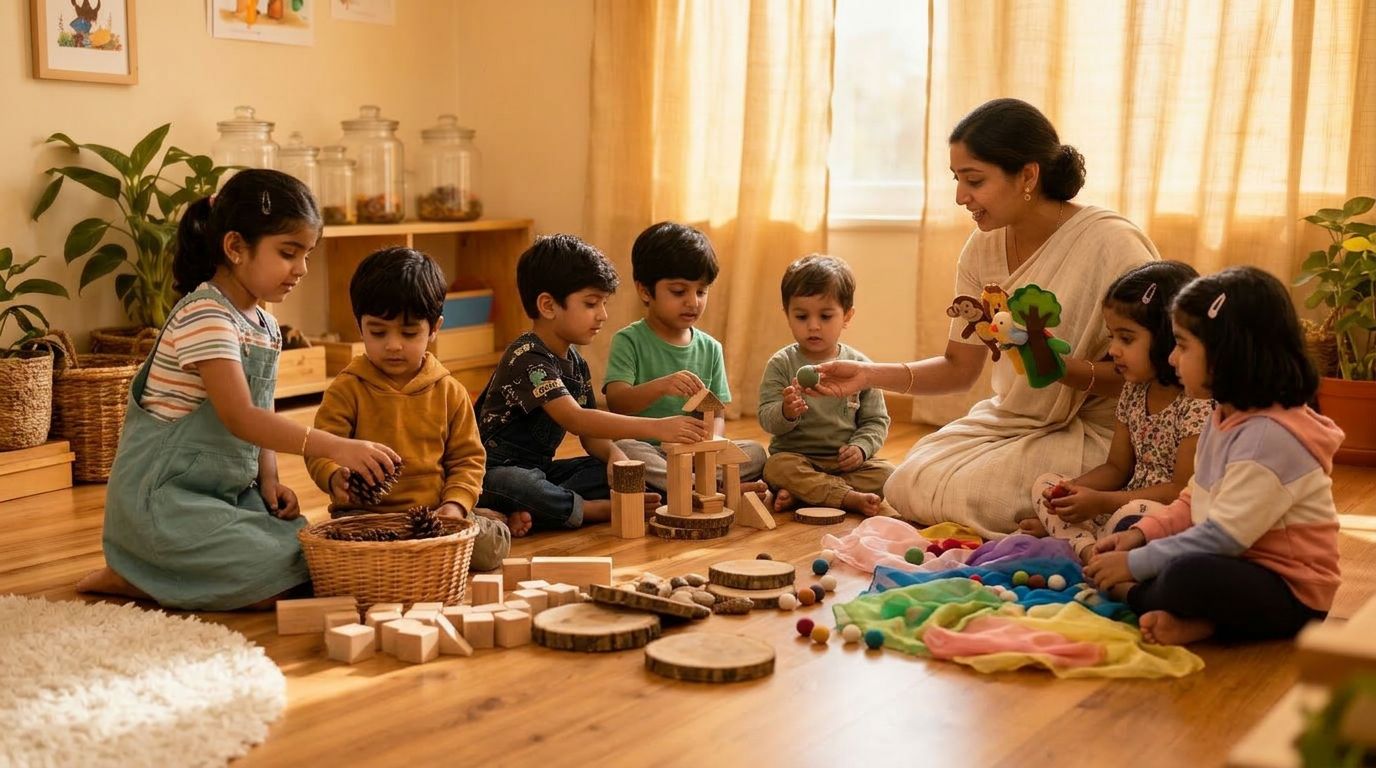
The emphasis is on rhythm, sensory experience, movement, language, and the security of loving repetition — but what parents often miss is how much cognitive work is hidden inside these simple moments.

A child spending twenty minutes building a bridge with wooden blocks is not 'just playing.' They are testing structural ideas, negotiating with a friend whose tower keeps collapsing, adapting their plan when the angle is wrong, and persisting through frustration until it stands. These are the exact capacities — flexible thinking, collaboration, persistence, spatial reasoning — that predict success in mathematics and science years later.

Our adults move slowly, speak softly, and offer the steadiness a small child needs. But they also observe closely, document thoughtfully, and share what they see. Instead of 'Today we played with blocks,' you might read: 'Today Aarav spent twenty minutes building a bridge with Sara. They negotiated ideas, tested structures, adapted when they collapsed, and persisted through frustration. This is engineering thinking in its earliest, most joyful form.'

As children grow, their world widens. Older children plan elaborate pretend-play scenarios that require sustained attention, complex language, emotional negotiation, and creative problem-solving. A five-year-old organising a 'train station' for younger friends is practising leadership, sequencing, empathy, and narrative structure — the very foundations of literacy and social competence.

We do not prepare children for school by hurrying them past childhood. We prepare them by making the learning that happens inside childhood visible — so parents can see, understand, and celebrate the extraordinary development unfolding in what looks like simple play.
Extended care

Daycare / Extended Care

02.
Soft watercolour sketch — children reading and resting on floor cushions by silk drapes

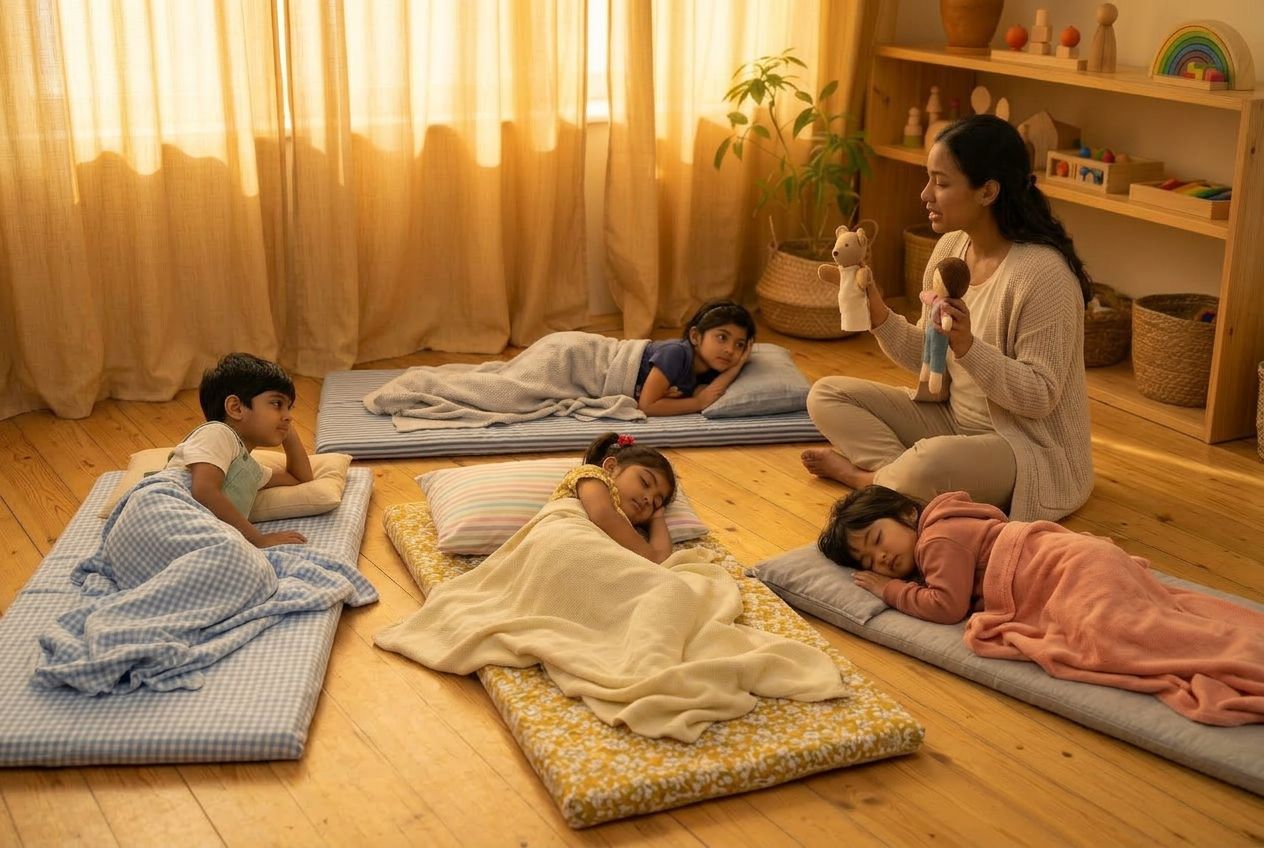
Our daycare is a calm, nurturing extension of the day — not a holding area, but a continuation of meaningful learning for working families.

Extended care follows the same spirit as the morning: familiar rhythms, mixed-age interactions, and caring relationships. A child who built a clay pot at ten o'clock might return at four to paint it, tell the story of what they made, and help a younger child roll their first ball of clay.

Afternoons include free play, stories, creative work, outdoor time, and rest. But they also offer something quieter and equally valuable: the chance to watch how older children handle disappointment, to practise asking for help, to settle into a book corner without being rushed along. These unhurried hours build emotional regulation and independence in ways that scheduled activities rarely can.

Parents often tell us their children arrive home calm, chatty, and deeply satisfied — not overstimulated or exhausted. That is because we believe long days away from home should still feel like childhood, not endurance.

What success looks like

The foundations that make everything else easier.

Ages 2 – 3

Security & sensory roots

Children are building trust in the world, a rich sensory vocabulary, and the first sparks of language. What you will see: a child who separates from you with growing confidence, who uses new words to describe feelings, who can focus on a simple task for several minutes without distraction.

Ages 3 – 4

Language & social wiring

Children are wiring language, empathy, and the ability to negotiate with peers. What you will see: elaborate pretend-play with plots and roles, the ability to ask for help using full sentences, conflict with friends followed by genuine repair, and stories told in sequential detail.

Ages 4 – 6

Independence & readiness

Children are consolidating focus, self-regulation, and the cognitive flexibility that makes formal learning possible. What you will see: sustained concentration on complex projects, the confidence to approach unfamiliar tasks, leadership shown toward younger children, and genuine curiosity about numbers, letters, and patterns — not because they were drilled, but because their minds are ready.

“I stopped worrying about whether my child could write their name before kindergarten when I saw them spend forty minutes solving a problem with their friends — negotiating, failing, trying again, and finally succeeding. That persistence will matter far more than any worksheet.”

— A Sketch parent

New measures of growth

Questions worth asking instead.

Many parents naturally ask: Can my child write A-Z? Can they count to one hundred? These are easy to test, but they are weak predictors of long-term success. Here are stronger signals to watch for — and the ones we actively cultivate at Sketch.

Can they solve problems independently?

A child who can sit with a challenge, try different approaches, and not give up at the first obstacle is building the exact mindset that drives achievement in every subject later.

Can they express feelings in words?

Emotional literacy — naming frustration, asking for help, describing joy — is one of the strongest predictors of healthy relationships and classroom behaviour.

Can they collaborate with others?

The ability to share ideas, compromise, and build something together is more valuable in adult life than solitary academic speed.

Can they stay engaged with a task?

Sustained attention is a trainable capacity. It underlies reading comprehension, mathematical reasoning, and every form of deep learning.

Do they approach the unfamiliar with curiosity?

A child who is not afraid to be wrong, who tries new materials without prompting, carries the engine of lifelong learning.

Do they recover from setbacks?

Resilience — the ability to feel disappointment and keep going — is built through safe struggle in childhood, not protected from it.

How academics emerge

We strengthen the roots so the branches grow naturally.

We don't delay learning — we build the capacities that make learning effortless. Early academics emerge naturally from strong developmental foundations. Here is what that looks like, in real moments from our classroom.

Example one

Writing emerges from motor & sensory foundations

Most schools teach writing by tracing letters, copying from the board, and pushing a pencil into a child's hand long before their body is ready. But writing is not a cognitive skill first — it is a motor and sensory and control skill first.

Before a child can write comfortably, they need shoulder stability, wrist rotation, finger strength, bilateral coordination, visual tracking and steady hand-eye control. None of these are built by worksheets.

At Sketch, instead of pencil drills, children:

  • climb, crawl and hang — building shoulder strength
  • knead clay — strengthening finger muscles
  • pour water — developing wrist control
  • thread beads — refining the pincer grip
  • draw freely — building mark-making confidence

By five or six, they can hold a pencil comfortably. Letter formation becomes easy. There is no resistance. Writing emerges — without force.

Example two

Reading emerges from language, story & play

Instead of phonics drills at three and a half, we build the deeper layer that makes reading effortless later — rich storytelling, slow conversations, vocabulary that stretches a little beyond a child's everyday speech, rhyming games, and sound awareness woven into songs.

In pretend play, a child writes MENU in their café. Another draws signs for their cardboard zoo. They are already experimenting with symbols — discovering that a mark on paper can carry meaning.

By five or six, they understand that symbols carry meaning. Phonics then becomes a tool, not a burden. Reading emerges because comprehension is strong, listening stamina exists, and curiosity is alive.

Example three

Math emerges from real-world play

Instead of worksheets on numbers, children count stones while building, compare whose tower has more blocks, measure water as they pour it from jug to jug, sort leaves by size, and divide pretend food fairly in dramatic play.

Through these everyday moments they come to understand quantity, more and less, pattern, measurement, and the early intuition of sharing that becomes division. By five or six, numerals are simply symbols for ideas they already grasp deeply.

What developmental science says

Executive function — attention, memory, flexibility — predicts school success far more reliably than early literacy drills. Build emotional regulation, focus during play, problem-solving and language depth, and academic learning arrives faster later. Children who begin formal academics at six often catch up within months and surpass early-drilled peers by later primary years.

“If you rush academics, you build surface skill without foundation. If you build foundation, skill comes easily, joyfully, sustainably.”

Come spend a morning with us.

We welcome families to visit Sketch — to walk through the rooms, meet the adults and feel the rhythm of the day for themselves.

Book a visit